

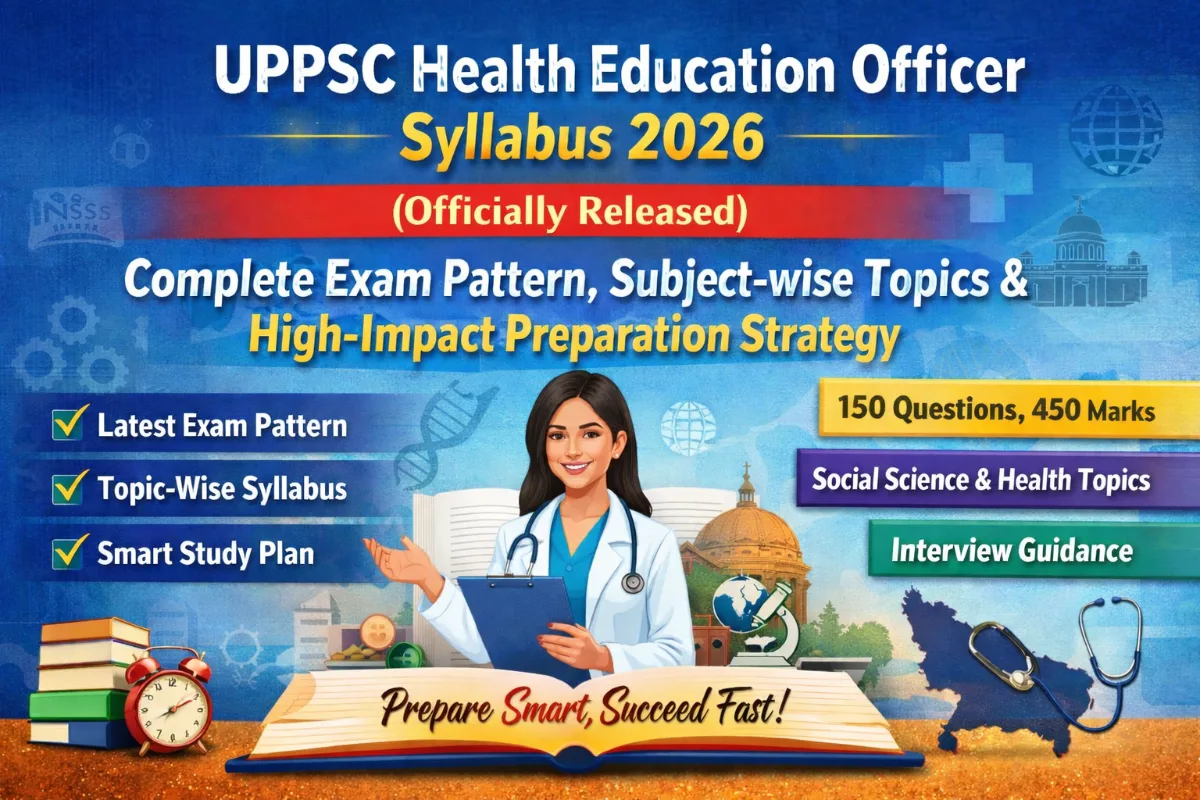
The UPPSC HEO Syllabus 2026 has been officially released by the Uttar Pradesh Public Service Commission (UPPSC), bringing much-needed clarity for candidates preparing for the Health Education Officer (HEO) exam. Earlier, aspirants were preparing without a defined syllabus, but now the commission has provided a structured and detailed framework for preparation.
This syllabus clearly indicates that the exam is not limited to traditional General Studies. Instead, it focuses on public health awareness, social science understanding, behavioral concepts, and policy-level knowledge, making it a multidisciplinary and concept-driven examination.
If you are planning to appear in this exam, understanding the UPPSC HEO Syllabus 2026 in depth is the first step toward a smart and result-oriented preparation strategy.
UPPSC HEO 2026 Exam Pattern — Detailed Structure
| Component | Details |
|---|---|
| Total Questions | 150 |
| Total Marks | 450 |
| Duration | 2 Hours |
| Question Type | Objective (MCQ) |
| Marks per Question | 3 Marks |
| Negative Marking | 1/3 Marks Deduction |
| Interview | 50 Marks |
Each correct answer carries 3 marks, while 0.33 marks are deducted for every incorrect answer. This marking scheme highlights the importance of accuracy and careful attempt strategy.
Section-wise Weightage — Key Strategy Insight
| Section | Subject | Questions | Marks |
|---|---|---|---|
| Part 1 | General Studies | 50 | 150 |
| Part 2 | Social Science & Health Knowledge | 100 | 300 |
The Social Science and Health Knowledge section carries 300 marks, which is nearly 66% of the total paper. This makes it the most important section for selection and ranking.
UPPSC HEO Syllabus 2026 — Subject-wise Detailed Analysis
1. General Studies — Strong Foundation Area
The General Studies section includes:
- Indian History (Ancient to Modern, Freedom Movement)
- Geography (India & World, Environment, Resources)
- Indian Polity (Constitution, Governance, Institutions)
- Economy (Development, Reforms, Welfare Policies)
- Agriculture (Crop Production, Pest Management)
- General Science (Class 10 level Physics, Chemistry, Biology)
- Mathematics (Basic Arithmetic, Algebra, Geometry)
This section is relatively scoring if your fundamentals are clear.
2. Community Medicine — Core Subject
This is one of the most important and job-oriented sections:
- National Health Mission (NHM)
- National Health Programs in India
- Behavior Change Communication (BCC)
- Community Mobilization
This section tests your understanding of how health systems function at the ground level.
Social Science & Health Knowledge — The Deciding Section
This section forms the backbone of the exam and demands deep conceptual understanding.
Sociology
- Social determinants of health
- Rural vs Urban health gap
- Poverty, sanitation, malnutrition
- Social inequality (caste, gender, economic status)
- Government health schemes
Focus on real-life application and analytical understanding.
Anthropology
- Human variation (tribal, rural, urban)
- Public health concepts
- Genetic and communicable diseases
- Blood groups (ABO, Rh)
This section connects biology with social context.
Psychology
- Learning, memory, intelligence
- Personality and motivation
- Psychological testing
- Social issues like stress and addiction
Conceptual clarity is essential here.
Social Psychology
- Human values and attitudes
- Social behavior and interaction
- Communication and persuasion
- Counseling and community health
Highly relevant for awareness and outreach roles.
Political Science
- Indian Constitution (FR, DPSP, Duties)
- Parliament, Judiciary, Executive
- Panchayati Raj and Local Governance
- Constitutional bodies
- Public policy
Focus on governance and policy implementation.
Geography
- Health geography
- Environmental impact on health
- Disease distribution
- Malnutrition and food security
Analytical approach is required.
History
- Ancient, Medieval, Modern India
- Freedom struggle
- World history (French Revolution, World Wars)
- Post-independence developments
Focus on concepts and impact.
Economics
- Poverty, unemployment, inequality, HDI
- Health economy
- Demography and migration
- Health infrastructure
Policy-based and practical section.
UPSSSC Platoon Commander Recruitment 2026 – Apply Online for 243 Posts
UPPSC HEO Syllabus 2026 in Hindi (पूरा सिलेबस हिंदी में)
अगर आप UPPSC HEO Syllabus 2026 को हिंदी में समझना चाहते हैं, तो नीचे पूरा सिलेबस सरल और स्पष्ट भाषा में दिया गया है। यह सिलेबस आधिकारिक पैटर्न के अनुसार तैयार किया गया है और परीक्षा की तैयारी के लिए अत्यंत महत्वपूर्ण है।
सामान्य अध्ययन (General Studies)
इस भाग में कुल 50 प्रश्न पूछे जाएंगे। इसमें निम्न विषय शामिल हैं:
- भारत का इतिहास एवं स्वतंत्रता संग्राम
(हड़प्पा संस्कृति, वैदिक काल, मौर्य वंश, गुप्त वंश, दिल्ली सल्तनत, मुगल काल, स्वतंत्रता आंदोलन) - भारत एवं विश्व का भूगोल
(भारत का भौतिक, आर्थिक एवं सांस्कृतिक भूगोल, संसाधन, कृषि, परिवहन, पर्यावरण, प्रदूषण, उत्तर प्रदेश का भूगोल) - भारतीय संविधान एवं राजनीतिक व्यवस्था
(संविधान, संघीय प्रणाली, राजनीतिक ढांचा, संवैधानिक निकाय, स्थानीय स्वशासन) - भारतीय समाज एवं अर्थव्यवस्था
(आधुनिकीकरण, नगरीकरण, औद्योगीकरण, आर्थिक सुधार, स्वास्थ्य एवं स्वच्छता, मानव विकास) - राष्ट्रीय एवं अंतर्राष्ट्रीय समसामयिक घटनाएं
- भारतीय कृषि
(मुख्य फसलें, उत्पादन तकनीक, कीट प्रबंधन, विपणन) - सामान्य विज्ञान (कक्षा 10 स्तर तक)
(पोषण, रोग, डीएनए, ऊर्जा, भौतिकी एवं रसायन विज्ञान के मूल सिद्धांत) - प्रारंभिक गणित
(संख्या पद्धति, बीजगणित, ज्यामिति, क्षेत्रफल एवं आयतन)
सामुदायिक चिकित्सा (Community Medicine)
यह भाग परीक्षा के लिए बहुत महत्वपूर्ण है:
- राष्ट्रीय स्वास्थ्य मिशन (NHM)
- भारत के राष्ट्रीय स्वास्थ्य कार्यक्रम
- स्वास्थ्य शिक्षा एवं व्यवहार परिवर्तन संचार (BCC)
- सामुदायिक भागीदारी एवं संसाधन प्रबंधन
सामाजिक विज्ञान विषयक ज्ञान (Social Science Related Knowledge)
इस भाग में 100 प्रश्न पूछे जाएंगे और यह सबसे महत्वपूर्ण सेक्शन है।
समाजशास्त्र (Sociology)
- स्वास्थ्य की अवधारणा एवं सिद्धांत
- ग्रामीण एवं शहरी स्वास्थ्य अंतर
- गरीबी, कुपोषण, स्वच्छता
- सामाजिक असमानता (जाति, लिंग, आर्थिक स्थिति)
- स्वास्थ्य से संबंधित सरकारी योजनाएं
मानव विज्ञान (Anthropology)
- मानव विविधता (जनजातीय, ग्रामीण, शहरी)
- जनस्वास्थ्य की अवधारणा
- आनुवंशिक एवं संक्रामक रोग
- रक्त समूह (ABO, Rh)
मनोविज्ञान (Psychology)
- अधिगम, स्मृति, बुद्धि
- व्यक्तित्व एवं प्रेरणा
- मनोवैज्ञानिक परीक्षण
- सामाजिक समस्याएं (तनाव, नशा, वृद्धावस्था)
सामाजिक मनोविज्ञान (Social Psychology)
- मानव मूल्य एवं दृष्टिकोण
- सामाजिक व्यवहार एवं अंतःक्रिया
- संचार एवं प्रेरणा
- परामर्श एवं सामुदायिक स्वास्थ्य
राजनीति विज्ञान (Political Science)
- भारतीय संविधान (मौलिक अधिकार, नीति निर्देशक तत्व)
- संसद, न्यायपालिका, कार्यपालिका
- पंचायती राज एवं स्थानीय शासन
- संवैधानिक संस्थाएं
- लोक नीति एवं प्रशासन
भूगोल (Geography)
- स्वास्थ्य भूगोल
- पर्यावरण का स्वास्थ्य पर प्रभाव
- रोगों का वितरण
- कुपोषण एवं खाद्य सुरक्षा
इतिहास (History)
- प्राचीन, मध्यकालीन एवं आधुनिक भारत
- स्वतंत्रता संग्राम
- विश्व इतिहास (फ्रांसीसी क्रांति, विश्व युद्ध)
- स्वतंत्रता के बाद के विकास
अर्थशास्त्र (Economics)
- गरीबी, बेरोजगारी, असमानता, HDI
- स्वास्थ्य अर्थव्यवस्था
- जनसंख्या एवं प्रवासन
- स्वास्थ्य अवसंरचना
Important Insights
- This is not a traditional GS-based exam
- It is a multi-disciplinary exam (Health + Society + Policy)
- Conceptual understanding is more important than memorization
Preparation Strategy (High Scoring Approach)
- Start with NCERT books (Class 6–10) for basics
- Focus on Sociology, Psychology, and Community Medicine
- Study government health schemes in detail
- Practice MCQs regularly
- Revise current affairs (health sector focus)
- Maintain consistent revision
Important Links
| UPPSC HEO Official Syllabus 2026 | Click Here |
| UPPSC Official Website | Click Here |
Frequently Asked Questions (FAQ)
Q1. What is UPPSC HEO Syllabus 2026?
It includes General Studies and Social Science with health-related topics.
Q2. What is the exam pattern?
150 questions, 450 marks, 2 hours duration with negative marking.
Q3. Which section is most important?
Social Science (300 marks).
Q4. Is there negative marking?
Yes, 1/3 marks deducted.
Q5. Is interview included?
Yes, 50 marks interview.
Q6. What should be the main focus?
Sociology, Psychology, and Community Medicine.
Conclusion
The UPPSC HEO Syllabus 2026 clearly shows that the exam is designed to test practical understanding, social awareness, and policy-level thinking. Candidates who prepare with a structured approach and focus on high-weightage sections will have a strong advantage.
Start your preparation early, stay consistent, and focus on conceptual clarity. With the right strategy, this exam can be your gateway to a respected government career.




Leave a Reply