

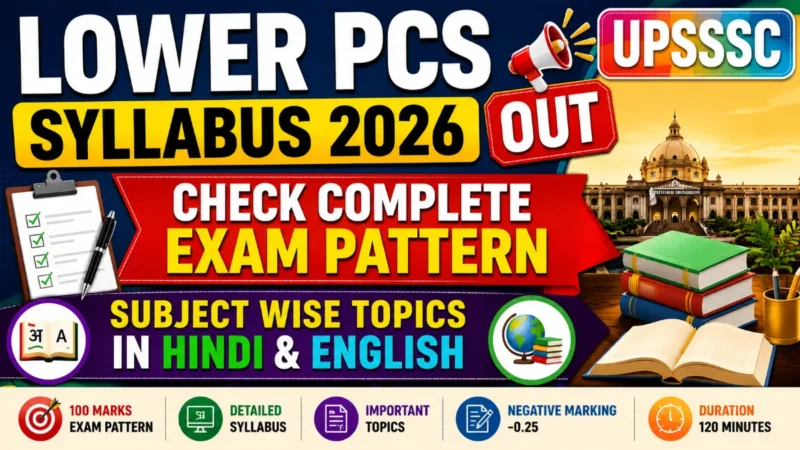
The Lower PCS Syllabus 2026 is the foundation of preparation for candidates appearing in the Combined Lower Subordinate Services Main Examination. The syllabus has been structured to assess a candidate’s understanding of General Studies, Computer & Information Technology, General Hindi, Current Affairs, and Uttar Pradesh-specific General Knowledge.
Unlike many state-level recruitment examinations that focus heavily on traditional General Studies, the latest Lower PCS Exam Pattern 2026 also gives significant weightage to Computer Awareness, Information Technology, Artificial Intelligence, Digital Tools, and Uttar Pradesh General Knowledge. This makes a clear understanding of the official syllabus essential for effective preparation.
Candidates preparing for posts such as Assistant Treasury Accountant, Auditor, Assistant Accountant, Executive Officer, Assistant Chakbandi Officer, District Assistant Training Officer, Mandi Supervisor, and other graduate-level posts should carefully study every section of the syllabus before beginning their preparation. The official examination pattern and syllabus outline are provided in the notification.
Lower PCS Mains Exam Overview
| Particular | Details |
|---|---|
| Exam Type | Objective (Multiple Choice Questions) |
| Total Questions | 100 |
| Total Marks | 100 |
| Duration | 120 Minutes |
| Language | Hindi & English |
| Negative Marking | 0.25 Marks Deduction for Each Wrong Answer |
| Marks Per Question | 1 Mark |
The examination is divided into three parts consisting of General Studies, Computer & Information Technology, and Uttar Pradesh General Knowledge. The official exam pattern specifies a total of 100 questions carrying 100 marks with a duration of 120 minutes.
Lower PCS Subject Wise Exam Pattern 2026
| Part | Subject | Questions | Marks |
|---|---|---|---|
| Part 1 | History of India and Indian National Movement | 5 | 5 |
| Part 1 | Indian Polity and Constitution | 10 | 10 |
| Part 1 | Geography of India and World | 5 | 5 |
| Part 1 | Indian Economy and Social Development | 10 | 10 |
| Part 1 | General Science | 5 | 5 |
| Part 1 | Environment, Ecology and Disaster Management | 10 | 10 |
| Part 1 | Current Events of National and International Importance | 5 | 5 |
| Part 1 | General Intelligence Test | 5 | 5 |
| Part 1 | Elementary Mathematical Knowledge | 5 | 5 |
| Part 1 | General Hindi | 5 | 5 |
| Part 2 | Computer & Information Technology | 15 | 15 |
| Part 3 | General Information Related to Uttar Pradesh | 20 | 20 |
| Total | 100 | 100 |
The highest-weightage sections are Uttar Pradesh General Knowledge and Computer & Information Technology, which together account for 35 marks of the paper.
Lower PCS Syllabus 2026 in English
Part 1: General Studies
1. History of India and Indian National Movement
This section evaluates the candidate’s understanding of India’s historical development and the freedom struggle.
Topics include:
- Ancient Indian History
- Medieval Indian History
- Modern Indian History
- Social, Cultural, Economic and Political Aspects of Indian History
- Indian National Movement
- Rise of Nationalism
- Freedom Struggle
- Contribution of Freedom Fighters
- Constitutional Development During the Freedom Movement
2. Indian Polity and Indian Constitution
This section focuses on India’s constitutional and governance framework.
Topics include:
- Indian Constitution
- Constitutional Development in India
- Political System
- System of Governance
- Panchayati Raj
- Local Self Government
- Public Policy
- Community Development
- Administrative Structure
3. Geography of India and World
Questions are designed to test knowledge of both Indian and world geography.
Topics include:
- Physical Geography of India
- World Geography
- Agriculture
- Horticulture
- Forestry
- Animal Husbandry
- Population Studies
- Urbanization
- Smart Cities
- Smart Villages
4. Indian Economy and Social Development
This section covers the economic structure and development process of India.
Topics include:
- Economic Planning
- Objectives and Achievements of Planning
- NITI Aayog
- Sustainable Development Goals (SDGs)
- Government Budget
- Financial System
- Agriculture Sector
- Industrial Development
- Trade and Commerce
- Land Reforms
- Globalization
- Liberalization
- Infrastructure Development
- Power Sector
- Ports
- Airports
- Railways
5. General Science
Questions are based on everyday scientific awareness rather than highly technical concepts.
Topics include:
- Physics
- Chemistry
- Biology
- Human Health
- Nutrition
- Vitamins
- Diseases
- Vaccination
- Drinking Water Standards
- Water Cycle
- Scientific Survey Techniques
- Role of Science and Technology in National Development
6. Environment, Ecology and Disaster Management
Topics include:
- Environment
- Ecosystem
- Wildlife Conservation
- Biodiversity
- Environmental Pollution
- Environmental Degradation
- Natural Resources
- Natural Disasters
- Disaster Management
7. Current Events of National and International Importance
Topics include:
- National Current Affairs
- International Current Affairs
- Major Government Policies
- Significant National Events
- Global Events
- Important Reports and Developments
8. General Intelligence Test
Questions test analytical and logical abilities.
Topics include:
- Logical Reasoning
- Analytical Ability
- Critical Thinking
- Decision Making
- Problem Solving
9. Elementary Mathematical Knowledge
Topics include:
- Arithmetic
- Algebra
- Geometry
- Statistical Analysis
- Graph Interpretation
- Diagram Analysis
10. General Hindi
Topics include:
- Official Correspondence
- Office Orders
- Notifications
- Circulars
- Hindi Grammar
- Synonyms
- Antonyms
- One Word Substitution
- Sentence Correction
- Idioms and Phrases
Also Read : UPSSSC Forest Guard Physical Standards 2026
Lower PCS Syllabus in Hindi
भाग-1 : सामान्य अध्ययन
भारतीय इतिहास एवं भारतीय राष्ट्रीय आंदोलन
- प्राचीन भारतीय इतिहास
- मध्यकालीन भारतीय इतिहास
- आधुनिक भारतीय इतिहास
- भारतीय राष्ट्रीय आंदोलन
- स्वतंत्रता संग्राम
- राष्ट्रवाद का उदय
- स्वतंत्रता प्राप्ति में महत्वपूर्ण घटनाएँ
भारतीय राजव्यवस्था एवं भारतीय संविधान
- भारतीय संविधान
- संवैधानिक विकास
- भारतीय राजनीतिक व्यवस्था
- शासन प्रणाली
- पंचायती राज
- स्थानीय स्वशासन
- सार्वजनिक नीति
- सामुदायिक विकास
भारत एवं विश्व का भूगोल
- भारत का भौतिक भूगोल
- विश्व भूगोल
- कृषि
- बागवानी
- वानिकी
- पशुपालन
- जनसंख्या
- नगरीकरण
- स्मार्ट सिटी
- स्मार्ट गाँव
भारतीय अर्थव्यवस्था एवं सामाजिक विकास
- आर्थिक नियोजन
- नीति आयोग
- सतत विकास लक्ष्य
- सरकारी बजट
- वित्तीय प्रणाली
- उद्योग
- व्यापार एवं वाणिज्य
- भूमि सुधार
- वैश्वीकरण
- उदारीकरण
- आधारभूत संरचना
सामान्य विज्ञान
- भौतिक विज्ञान
- रसायन विज्ञान
- जीव विज्ञान
- स्वास्थ्य एवं पोषण
- विटामिन
- रोग
- टीकाकरण
- पेयजल मानक
- विज्ञान एवं प्रौद्योगिकी
पर्यावरण, पारिस्थितिकी एवं आपदा प्रबंधन
- पर्यावरण
- पारिस्थितिकी तंत्र
- वन्य जीव संरक्षण
- जैव विविधता
- प्रदूषण
- पर्यावरणीय क्षरण
- प्राकृतिक संसाधन
- प्राकृतिक आपदाएँ
- आपदा प्रबंधन
राष्ट्रीय एवं अंतर्राष्ट्रीय महत्व की समसामयिक घटनाएँ
- राष्ट्रीय घटनाएँ
- अंतर्राष्ट्रीय घटनाएँ
- सरकारी योजनाएँ
- महत्वपूर्ण विकास
- वैश्विक घटनाएँ
सामान्य बुद्धि परीक्षण
- तार्किक क्षमता
- विश्लेषणात्मक क्षमता
- निर्णय क्षमता
- समस्या समाधान
प्रारम्भिक गणितीय ज्ञान
- अंकगणित
- बीजगणित
- ज्यामिति
- सांख्यिकीय विश्लेषण
- ग्राफ एवं आरेख
सामान्य हिन्दी
- शासकीय पत्र
- कार्यालय आदेश
- अधिसूचना
- परिपत्र
- विलोम शब्द
- पर्यायवाची शब्द
- मुहावरे एवं लोकोक्तियाँ
- वाक्य शुद्धि
- शब्द शुद्धि
Also Read : UPSSSC AGTA Recruitment 2026
Part 2: Computer & Information Technology Syllabus
This section carries 15 marks and includes both foundational computer knowledge and emerging technologies.
Computer Fundamentals
- History of Computers
- Introduction to Computers
- Information Technology
- Internet
- World Wide Web (WWW)
Hardware and Software
- Computer Hardware
- Computer Software
- Input Devices
- Output Devices
Networking Concepts
- Internet Protocol (IP Address)
- Internet Applications
- Networking Basics
Digital Communication
- Creation and Use of Email
- Email Operations
Office Applications
- MS Word
- MS Excel
Operating Systems
- Operating System Concepts
- Functions of Operating Systems
Digital Governance and Applications
- Social Networking
- E-Governance
- Digital Financial Tools
Cyber Security
- Cyber Threats
- Cyber Security Awareness
- Safe Digital Practices
Emerging Technologies
- Artificial Intelligence (AI)
- Big Data Processing
- Deep Learning
- Machine Learning
- Internet of Things (IoT)
The syllabus specifically includes contemporary technological developments and innovations in the field of Information Technology.
Part 3: Uttar Pradesh General Knowledge Syllabus
This is the highest-weightage section of the examination carrying 20 marks.
Topics include:
- History of Uttar Pradesh
- Culture of Uttar Pradesh
- Art and Architecture
- Festivals
- Folk Dances
- Literature
- Regional Languages
- Heritage
- Social Customs
- Tourism
- Geographical Landscape
- Environment
- Natural Resources
- Climate
- Soil
- Forests
- Wildlife
- Mines and Minerals
- Economy
- Agriculture
- Industry
- Business and Employment
- Politics and Administration
- Current Events Related to Uttar Pradesh
- Major Achievements of Uttar Pradesh
Important Weightage Analysis
| Section | Marks |
|---|---|
| Uttar Pradesh General Knowledge | 20 |
| Computer & Information Technology | 15 |
| Indian Polity & Constitution | 10 |
| Indian Economy & Social Development | 10 |
| Environment & Disaster Management | 10 |
These five areas alone contribute 65 marks, making them the most important sections of the examination.
Also Read : UPSSSC Lower PCS Notification 2026 Released for 2285 Vacancies, Check Eligibility & Apply Online
Negative Marking Rule
| Response Type | Marks |
|---|---|
| Correct Answer | +1 |
| Wrong Answer | -0.25 |
| Unattempted | 0 |
Candidates should focus on accuracy because incorrect answers reduce the overall score.
Important Links
| Action | Direct Access |
|---|---|
| Lower PCS Notification | Click Here |
| Lower PCS Apply Online | Click Here |
| Lower PCS Syllabus PDF | Click Here |
FAQs
How many questions are asked in Lower PCS 2026 Main Examination?
The examination contains 100 objective-type questions carrying 100 marks.
What is the duration of the examination?
The examination duration is 120 minutes.
Is there negative marking in Lower PCS 2026?
Yes. A deduction of 0.25 marks is applicable for every incorrect answer.
Which section carries the highest marks?
Uttar Pradesh General Knowledge carries the highest weightage with 20 marks.
How many marks are allotted to Computer & Information Technology?
The Computer & Information Technology section carries 15 marks.
Is the syllabus available in both Hindi and English?
Yes. The examination and syllabus are available in both Hindi and English formats.
Conclusion
The Lower PCS Syllabus 2026 is designed to assess a candidate’s overall understanding of General Studies, Indian Constitution, Economy, Geography, Science, Environment, Information Technology, General Hindi, and Uttar Pradesh-specific knowledge. The official exam pattern allocates significant weightage to Computer & Information Technology and Uttar Pradesh General Knowledge, making these sections particularly important for scoring well in the examination. Candidates who align their preparation strictly with the official syllabus and weightage structure can approach the Lower PCS Main Examination with a clear and focused strategy.


Leave a Reply